
FAQs

P3
Public-private partnerships (P3s) are long-term agreements between public agencies and private entities to build, expand or refurbish public infrastructure and provide operations and/or maintenance services. P3s provide greater private sector participation in the financing and delivery of public infrastructure projects when compared with the traditional design-bid-build procurement model.
The P3 delivery method allows for private investment to fill the gap in funding availability so that the needed transportation improvement project could be implemented.
-
$150M - IIJA Mega Grant Discretionary Award
-
$100M - American Rescue Plan Act
-
$240M - First 6 years of Vehicle Sales Tax
-
$85M - State General Obligation Bonds
-
$75M - HHP (TTF Federal)
-
$150M - State General Fund
-
The estimated cost for design and construction is $2.3B. Construction is anticipated to be completed in 2031.
This is a historic transportation infrastructure investment for the region. LA DOTD estimates the $2.3B construction investment for the Calcasieu Bridge will generate a total economic output of $3.29B within the Lake Charles Metropolitan Statistical Area (MSA) and create more than 16,000 jobs during its lifecycle.
Environmental
Geotechnical investigations are performed to learn about the physical properties of the rocks and soil near locations that are being considered for construction.
Geotechnical engineers are tasked with determining whether or not the ground is suitable for the proposed construction project. Through geotechnical drilling or boring, engineers can sample and test organic materials throughout the site, alerting contractors to unsuitable foundation soils.
You can learn more about the environmental process by visiting https://i10lakecharles.com/.
During the geotechnical investigation stage, the project team will request access to various properties. The property owner will be notified by letter and has the right to grant or deny access. If access is not denied per the instructions on the letter, the team will move forward with accessing the property.
Right-of-Way
The Right-of-Way team will contact impacted property owners once the final design and project limits are determined. Please see the LA DOTD Right of Way manual for more information.
Property owners whose property is directly impacted by the project’s right-of-way needs have been contacted directly by the project team with specific information.
Right-of-way impact information for Phase 2 has not been updated since the Conceptual Stage Relocation plan was developed. Phase 2 acquisitions and relocations are being performed by DOTD, but only when requested by the property owner and only for voluntary acquisitions and relocations. If you have any questions, please contact District 07 Right of Way Regional Supervisor, Robert Richard, 337-262-6250.
Construction
Yes, the bridge is safe for daily travel. The bridge is strictly monitored, inspected, and evaluated on a regular schedule to ensure its structural integrity remains sound while it is in service.
The project is a public-private partnership managed by LA DOTD in collaboration with Calcasieu Bridge Partners, a joint venture responsible for designing, building, financing, operating, and maintaining the bridge.
The estimated cost for design and construction is $2.3B. Construction is anticipated to last 7 years.
The project is in the construction phase. Crews are currently finalizing interim designs, relocating utilities, acquiring rights-of-way, and conducting test piling and trial embankments to prepare the site for major construction.
Spring 2026.
Major construction activities have started to begin after the groundbreaking, marked by a significant increase in equipment, materials, and personnel in the project corridor. Utility relocation for the project has already begun.
The new bridge is currently anticipated to open to traffic in 2030 with all construction being completed in 2031.
No. A major priority for this project is maintaining regional mobility. I-10 will remain open throughout the entire construction phase of the new bridge.
While the main bridge will remain open, there will be local traffic impacts. As construction ramps up, drivers should expect localized temporary lane shifts, shoulder closures, and detours. Upcoming activities include work along PPG Drive and at the I-10/I-210 interchange.
Yes, local traffic will be impacted during construction and detours will be implemented in the City of Westlake.
Commuters should plan for minor delays due to active work zones, an influx of construction vehicles entering and exiting the highway, and the hauling of heavy materials. All drivers are urged to stay alert, reduce speeds in work zones, and monitor project updates for specific closure announcements.
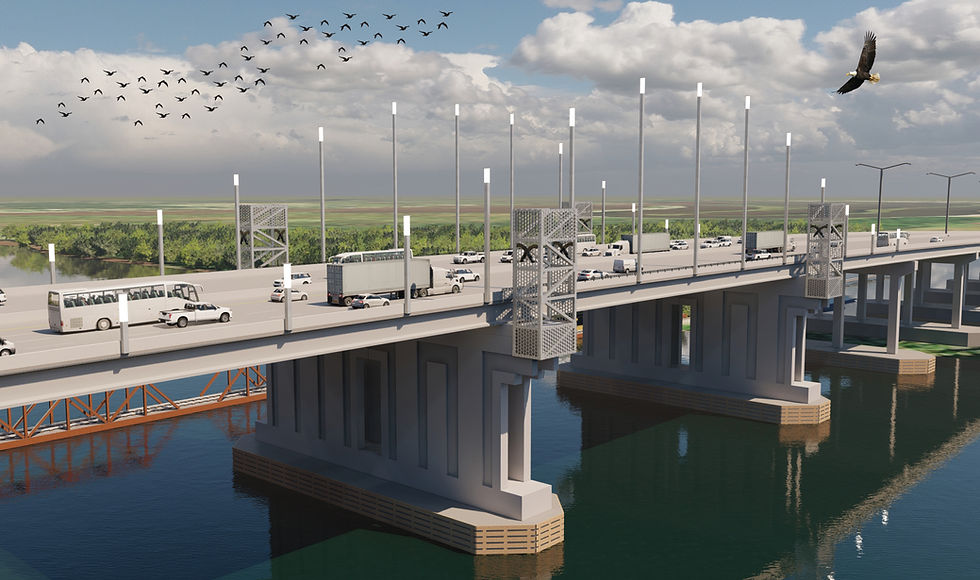
The new bridge will feature three full travel lanes in each direction, plus an auxiliary lane on each side for safer entering and exiting. It will also include full shoulders on both sides of the roadway, center barriers, and modern roadway lighting. It will have a lower vertical clearance and a much more gradual incline than the current bridge, making it easier to cross, particularly for commercial trucks. Although it will not include the same crossed pistols seen in the current bridge’s design, there are plans to incorporate a nod to the iconic pistols in the new bridge’s design aesthetic.
The project is needed because the geometric and structural design of I-10 between its logical termini at I-210 on the West End on the Calcasieu River Bridge do not meet current design guidelines for freeways, ramps, and frontage roads for this section of the Interstate Highway System. The age, condition, and structural issues of the existing bridge limit its useful life. The configuration of the interchange at Sampson Street and presence of at-grade railroad crossings do not adequately serve the existing and planned future traffic in Westlake. Bottlenecks at the bridge and at the Sampson Street interchange that already impact traffic and safety on the interstate are predicted to get worse in future. The number of crashes in the project corridor surpassed statewide averages for crashes on multi-lane highways.
The purpose of the project is to:
-
Address the lack of system continuity on I-10 and along Sampson Street;
-
Reduce congestion and improve mobility on I-10 and along Sampson Street
-
Address structural and functional roadway and bridge deficiencies
-
Address safety concerns on I-10 and the Calcasieu Bridge
-
The pistols will be provided to the LA DOTD and follow the state's process for salvaged state property.
As employment opportunities become available, they will be posted here.
You can sign up for project updates by clicking here.
Tolling
Tolling is necessary to help fund a project of this magnitude and will be implemented once construction of the entire corridor is complete in 2031. Once completed, an all-electric tolling system will be used. Vehicles won’t slow down or stop to pay, as cameras and toll tag detection devices will assess tolls while vehicles maintain speed. Drivers will be billed either through their pre-paid toll tag accounts or via “pay by mail” using license plate reader technology. There will be a local tolling discount, and the actual toll rates will be established closer to the bridge completion dates. No tolls will be collected while the current bridge is still in use.
Tolling is necessary to partially fund this project because sufficient funding is otherwise not available.
Tolling will be in place for 50 years (2031 - 2081).
No, you can cross the bridge without a GeauxPass toll tag, but vehicles without a toll tag will be tolled at a higher rate.
Yes, there will be a local customer service center available.

GeauxPass (toll tag) account holders with non-commercial vehicles registered in Allen, Beauregard, Calcasieu, Cameron or Jefferson Davis Parishes receive a local vehicle discounted toll rate.
Toll tag account holders pay the rates below subject to inflation. Non-Toll Tag account holders will pay a higher rate. (NOTE: Toll rates below are as of 2023, subject to change each year based on inflation.)
HOV's may be eligible for a lower toll rate.
GeauxPass, Louisiana's statewide tolling system, warns residents of a nationwide "smishing" (text message) and "phishing" (email) scam. The scammers are using text messages and emails to falsely represent a tolling agency and make false claims that a toll payment is due.
The fake messages direct recipients to an unaffiliated website, where they are asked to provide personal and financial information to settle alleged balances. GeauxPass will never ask for personal information via text or email.
You can learn more about the scam here.
Credit card processing fees (3%, rounded to the nearest cent) will be added to each transaction for accounts funded with a credit card. GeauxPass accounts funded via check or e-check will not incur a processing fee.
There is no volume discount for crossing. Discounted rates are available for residents of the 5-parish region who have a GeauxPass Account and a toll tag on their vehicle.
Computer controlled cameras and toll tag detection devices mounted above travel lanes will assess tolls, allowing traffic to flow freely. There are no toll booths.
Toll revenue will be used to maintain and operate the bridge during the 50-year tolling period, and to repay the private investment that made construction of this bridge possible.

